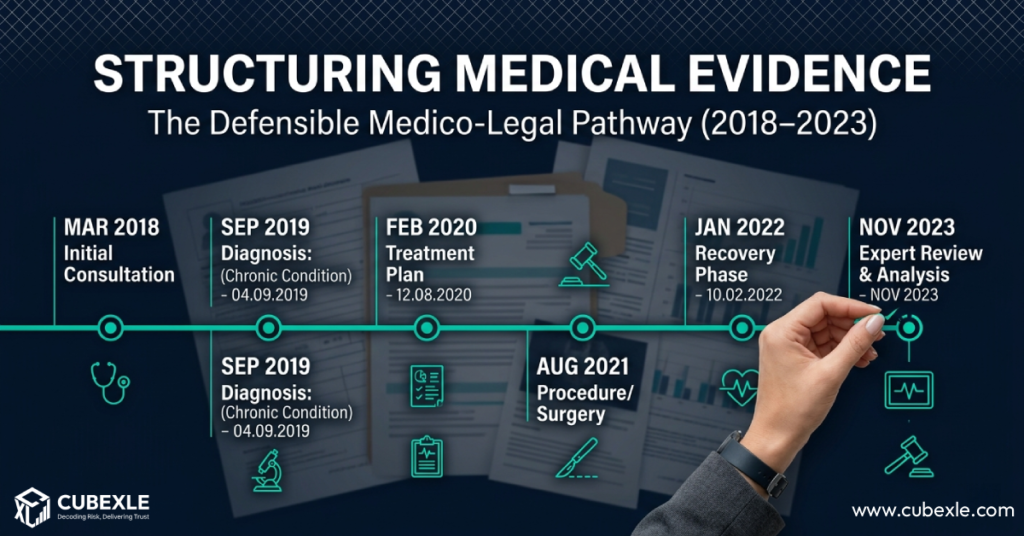
A medical chronology is one of the most powerful documents in any personal injury or medical malpractice case. When it is built correctly, it becomes the backbone of deposition prep, expert testimony, demand packages, and settlement negotiations. When it is built poorly, it becomes a liability.
Courts, opposing counsel, and expert witnesses do not need narrative. They need verifiable, date-ordered facts with direct references to source documents. A chronology that cannot be verified at the page level is a chronology that will be challenged.
Yet errors in medical chronologies remain surprisingly common — and surprisingly costly. Missing a two-month gap in care, failing to capture a prior diagnosis, organizing records by document date rather than event date, or presenting clinical findings in jargon that a jury cannot understand: each of these errors weakens a case that should be strong.
This guide covers what makes a medical chronology truly court-ready, the most common errors that undermine litigation outcomes, and the best practices that separate professional-grade litigation support medical records chronologies from rushed, unreliable summaries.
What Does ‘Court-Ready’ Actually Mean?
The phrase is used frequently. It is not always applied consistently. A court-ready medical chronology meets a specific and high standard:
- It is sourced: Every entry links to a specific page and document in the original medical records. Not a provider name. Not a general timeframe. A specific page number.
- It is complete: No relevant records have been excluded. Missing records are noted explicitly, not silently omitted.
- It is organized by event date, not document date: A discharge summary written on June 20 may describe events from June 15 to June 19. Those events belong on their actual dates in the timeline.
- It is clinically accurate: Diagnoses, procedures, and medications are described accurately, without distortion or over-simplification.
- It is accessible: Clinical shorthand and unexplained abbreviations are expanded for non-medical readers, including judges, jurors, and adjusters.
- It is reproducible: Another reviewer, given the same records, should arrive at the same chronology. The methodology must be defensible.
A litigation-ready medical chronology does more than list encounters. It is built to support expert analysis by organizing records in a way that allows experts to orient themselves quickly and respond accurately under cross-examination. — Trivent Legal, 2026
The Eight Most Common Errors in Medical Chronologies
Based on patterns observed across tens of thousands of case files, these are the errors that appear most frequently — and create the most significant downstream problems.
Error 1: Organizing by Document Date Instead of Event Date
This is the most technically consequential error in chronology construction. Documents arrive on different dates than the events they describe. A hospital record may be transcribed days after the patient was discharged. An operative report may be signed a week after surgery. Using the document date creates a misleading timeline.
Best practice: All events must be placed at their actual date of occurrence, not at the date the document was produced or signed.
Error 2: Omitting Minor Details
Legal teams often request summary-level chronologies to save time. The problem is that what looks minor in the record can become significant in deposition. A notation about mild pre-existing shoulder discomfort mentioned in passing in a routine intake note may become critical when the defense raises alternative causation.
Best practice: Include all clinically documented details, even those that appear tangential. Flag items that may be strategically significant without editorializing about their merit.
Error 3: Failing to Note Missing Records
A chronology that presents what is there without noting what should be there is incomplete. If a patient has documented visits to a specialist over six months but only three of those records appear in the file, that gap must be flagged explicitly. Missing records may represent lost evidence, unrequested records, or a gap in care that affects damages.
Best practice: All gaps in the record chain must be identified and noted with specificity — which provider, which timeframe, and whether a records request has been made.
Over 80% of health insurance claim denials stem from incomplete or disorganized medical documentation. In litigation, the standard is even higher. What is not documented cannot be assumed — and what is assumed without documentation will be challenged.
Error 4: Inadequate Citation Structure
A chronology entry that reads ‘Patient treated for lower back pain, November 2024’ is legally valueless without a citation. If opposing counsel or a court requests the source, and the reviewer cannot immediately point to the exact page and document, the credibility of the entire chronology is compromised.
Best practice: Every entry must include a direct citation: provider name, document type, and page number. This is not optional — it is the standard.
Error 5: Excessive Clinical Jargon
Chronologies are read by attorneys, adjusters, jurors, and judges. A finding described as ‘degenerative disc disease at L4-L5 with foraminal stenosis on the right at L5-S1 causing radiculopathy’ may be clinically precise but is not accessible to a non-medical reader. Medical chronologies that fail to translate clinical language lose their persuasive value outside the examining room.
Best practice: Expand all abbreviations. Provide plain-language translations of diagnoses and findings immediately following technical descriptions.
Error 6: Unresolved Contradictions
When two providers disagree — one documents full range of motion, another documents restricted range of motion two weeks later — that contradiction does not resolve itself in the chronology. It must be flagged, not silently absorbed.
Best practice: All clinical contradictions and inconsistencies between providers or records must be identified and noted. Their interpretation is for the attorney and expert witness — not the chronologist.
Error 7: No Pre-Existing Condition Identification
Every personal injury defense will probe pre-existing conditions. A chronology that fails to identify relevant prior diagnoses, prior treatments for similar complaints, or prior imaging findings leaves the plaintiff attorney unprepared and the defense attorney with an advantage.
Best practice: A dedicated pre-existing condition section should be included in every comprehensive chronology, cross-referenced with the main timeline and linked to source pages.
Error 8: Inconsistent Quality Across a Case File
In high-volume practices, paralegal teams may produce chronologies on a rolling basis across multiple cases. When there is no standardized format, no consistent citation protocol, and no quality review step, the resulting chronologies vary in depth and reliability. This creates risk not just at the case level but at the firm level.
Best practice: Chronology production should follow a documented methodology with standardized templates, review checkpoints, and a final quality assurance step before delivery.
Best Practices: Building a Chronology That Holds Up
The following table summarizes the core standards for court-ready litigation support medical records chronologies:
| Element | Standard |
| Event Dating | Organized by actual date of occurrence, not document creation date |
| Source Citation | Every entry cites provider, document type, and specific page number |
| Completeness | All providers, all records, all dates covered; gaps explicitly noted |
| Pre-Existing Conditions | Dedicated section with source citations and timeline cross-references |
| Clinical Language | Abbreviations expanded; plain-language translations included throughout |
| Contradictions | All discrepancies flagged, not resolved — interpretation left to attorney |
| Format | Consistent, structured layout; searchable; compatible with case management platforms |
| Quality Review | Final human review by a trained medical professional before delivery |
The Role of AI in Modern Medical Chronology Production
Artificial intelligence is now embedded in most professional medical chronology workflows. Its role is significant, but bounded.
AI tools excel at the structural tasks: sorting documents, extracting dates, identifying providers, building a working timeline from unstructured text. Platforms now exist that can produce a working chronology from a 1,000-page record set in a fraction of the time that manual production requires.
But the best practices described above — identifying clinically significant details, flagging contradictions, evaluating pre-existing conditions in context, translating clinical language for legal audiences — require human medical expertise. The AI-generated draft is a starting point. The court-ready output requires professional review.
Courts expect transparency about AI-assisted work product. Opposing counsel will challenge chronologies produced by AI if there is no documented human verification process. Source citations must still link to the original record. Event dating must still be manually verified. Clinical judgment cannot be delegated to an algorithm. — Supio, AI Medical Chronology Guide, 2025
The firms and vendors that deliver the strongest outcomes in 2026 are those operating a human-in-the-loop model: AI handles structural processing and first-draft production; trained medical professionals validate, annotate, and finalize the output.
This is precisely the model that CUBEXLE uses across its court ready medical chronologies services. Our medical experts bring 8 to 12 years of hands-on experience reviewing complex case files. They do not simply accept AI-generated output. They interrogate it, correct it, and build the final product to the standard that litigation requires.
How to Organize Medical Records for Litigation: A Starting Framework
Whether you are building chronologies in-house or evaluating an outsourced litigation support medical records chronology service, this framework governs best-practice organization:
anization:
- Collect all records before beginning: Request records from every provider identified in the intake, including imaging centers, pharmacies, and specialist referrals. Do not begin the chronology until the record set is as complete as possible.
- Audit for missing records: Cross-reference the records received against the providers mentioned in the records you have. Identify gaps and flag outstanding requests.
- Sort by event date: Organize all documents chronologically by the actual date of medical events, not the date of document creation or receipt.
- Classify by document type: Tag each document — office visit, operative report, radiology, discharge summary, prescription, physical therapy, etc. This enables quick navigation during deposition and expert review.
- Extract and structure the timeline: Build the master chronology, capturing diagnoses, treatments, procedures, medications, and provider assessments at each event date.
- Identify and flag pre-existing conditions: Search the record set for any prior diagnoses, treatments, or complaints relevant to the current claim. Cross-reference with the main timeline.
- Flag gaps and contradictions: Note all breaks in care, missing records, and provider discrepancies explicitly in the chronology.
- Quality review: Have a trained medical professional review the completed chronology for accuracy, completeness, and clinical interpretation before delivery.
What Attorneys Lose When Chronologies Are Weak
The downstream consequences of a poorly built medical chronology are concrete:
- Expert witness preparation suffers: Experts rely on chronologies to form defensible opinions efficiently. A disorganized or incomplete chronology forces experts to review raw records themselves — at significant cost in both time and fees.
- Depositions become vulnerable: Opposing counsel will probe discrepancies. If your chronology cannot account for a gap in care or a prior diagnosis that appeared in an overlooked record, the deposition becomes reactive rather than strategic.
- Settlement negotiations weaken: A demand package built on an incomplete medical chronology understates damages and misrepresents the medical picture. This costs plaintiffs settlement value and costs defense teams credibility.
- Case strategy is built on an incomplete foundation: Every litigation decision — from which experts to retain to which arguments to advance — flows from the medical evidence. If the medical evidence is not accurately organized, the strategy built on it is compromised.
The Standard Is High. The Cost of Missing It Is Higher.
A medical chronology is not a summary. It is the evidentiary backbone of medical-legal cases. It is what experts cite, what attorneys argue from, and what courts evaluate.
Getting it right requires more than competent data entry. It requires medical expertise, legal-contextual awareness, rigorous quality standards, and a documented, reproducible methodology.
At CUBEXLE, our litigation support medical records chronologies are built by trained medical professionals with deep experience in workers’ compensation, personal injury, medical malpractice, mass tort, and IME preparation. Every chronology we deliver is page-cited, quality-reviewed, and built to hold up under the scrutiny that litigation demands.
If you are working with chronologies that cannot answer a deposition challenge at the page level, it is time to raise the standard.